 CONSUMER_APP_INDEX
Funnel Walk · October 30, 2026 · ~7 min read
3 million visits a month: Muscle Booster’s Tai Chi funnel and the secrets in plain sight
Muscle Booster has not dropped below 1.9 million visits a month all year, and it has topped 3 million every month since April. A brand at that scale knows which screens convert. Its newest funnel, a Tai Chi plan for men, puts those lessons on show. We walked all 38 screens to find them.
Funnel Walk · Consumer App Index · October 30, 2026
The “Bloomberg Terminal” for Web2App Quiz Funnels
Track the ads, funnels, and pricing of every major web2app player — new funnels land in the terminal the same week we capture them.
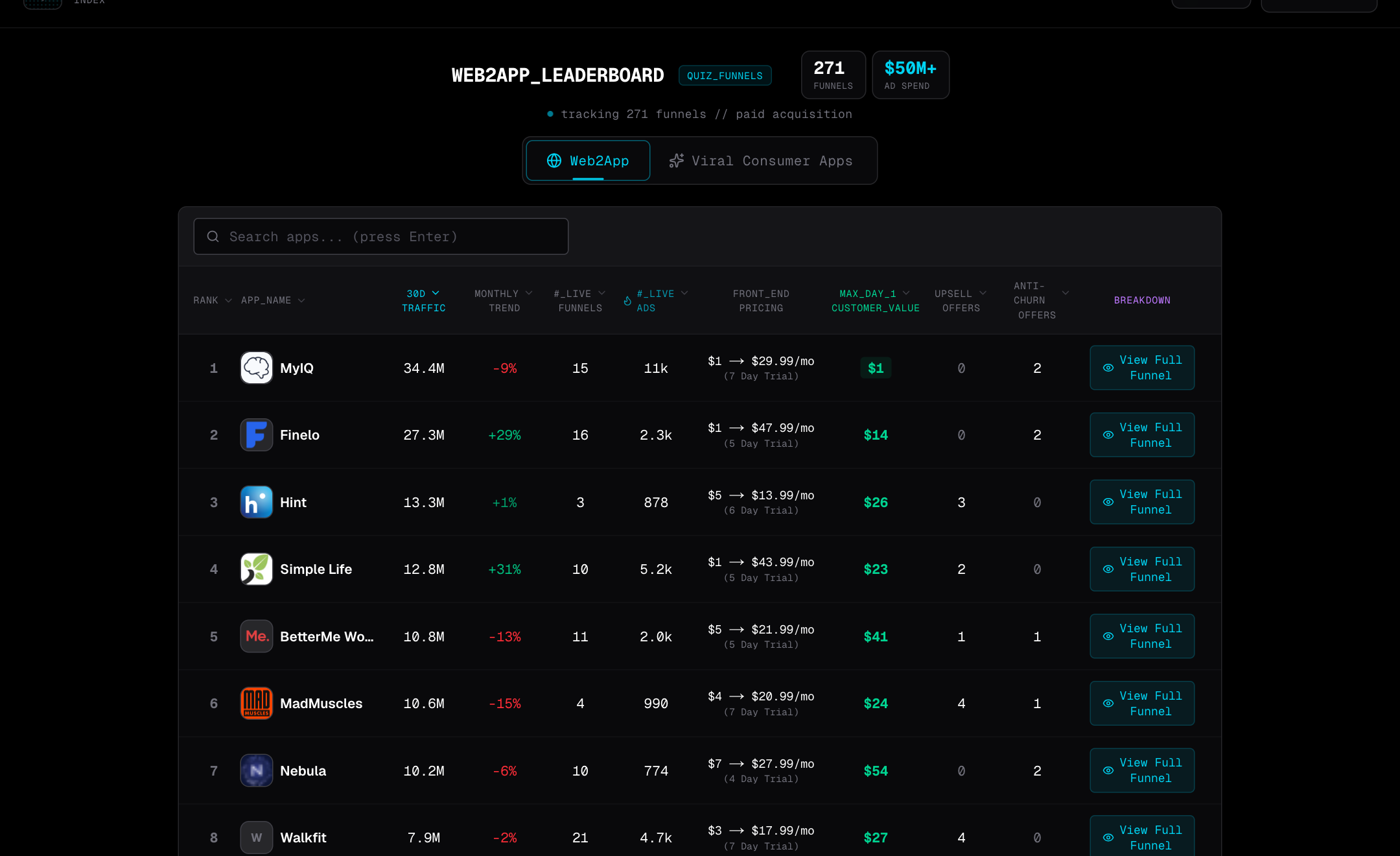
Already a member? Open Muscle Booster in the terminal → both captures, September and October, are inside
- 📈 3M+ visits a month, and an estimated $26.4M of Tai Chi YouTube ads pointed at this one funnel
- 🔢 An age-grid door, a score halfway through, and a goal weight with a date on it
- 🏃 Two clocks on the paywall, and the 71%-off sheet that opens when you try to leave
None of it is hidden. The door is an age grid, the score lands halfway through, the plan is built from four typed numbers and a goal weight with a date on it, and the paywall runs two clocks before a deeper discount waits at the exit. Our read: each one is a lesson a brand keeps only after paying to test it. Here they are in the order a buyer meets them.
Context · The trafficSix straight months above 3 million visits
Traffic to muscle-booster.io grew fivefold from December to May and has held above three million a month since. The Tai Chi ads on YouTube started at the end of January, when the climb was already under way.
The chart counts the whole domain, every funnel and branch together. Read it as the size of the business behind this quiz, not as the Tai Chi branch on its own.
| Aug 2025 | 1.42M | |
| Sep 2025 | 1.00M | |
| Oct 2025 | 1.04M | |
| Nov 2025 | 0.65M | |
| Dec 2025 | 0.93M | |
| Jan 2026 | 1.91M | |
| ↑ Jan 28: first Tai Chi YouTube ad in our tracker | ||
| Feb 2026 | 1.97M | |
| Mar 2026 | 2.95M | |
| Apr 2026 | 4.44M | |
| May 2026 | 4.93M | |
| Jun 2026 | 4.78M | |
| Jul 2026 | 3.15M | |
| Aug 2026 | 3.13M | |
| Sep 2026 | 3.36M | |
Monthly visits to muscle-booster.io, Aug 2025 to Sep 2026. SimilarWeb estimates for the whole domain.
Context · The ads behind the doorThe ads say Tai Chi, and they all land here
Muscle Booster feeds this quiz from YouTube and Meta. The creative on both says Tai Chi: chair routines, seated moves, older men standing tall. Every Tai Chi ad in the live Meta set clicks through to the branch walked below. On YouTube, the Tai Chi ads carry an estimated $26.4 million in spend since late January, more than half of all the Muscle Booster YouTube spend we track.



The landing page is an age grid. Hello comes third.
You arrive from a Tai Chi ad and meet four pairs of people, each under an age bracket. There is no headline about muscle and no start button. You tap your decade and you are in.
Gender is screen two. Only then does Muscle Booster say hello: a welcome card, two men squatting, and a promise to ask a few questions. The pitch is one sentence long, and the reader has already answered twice.
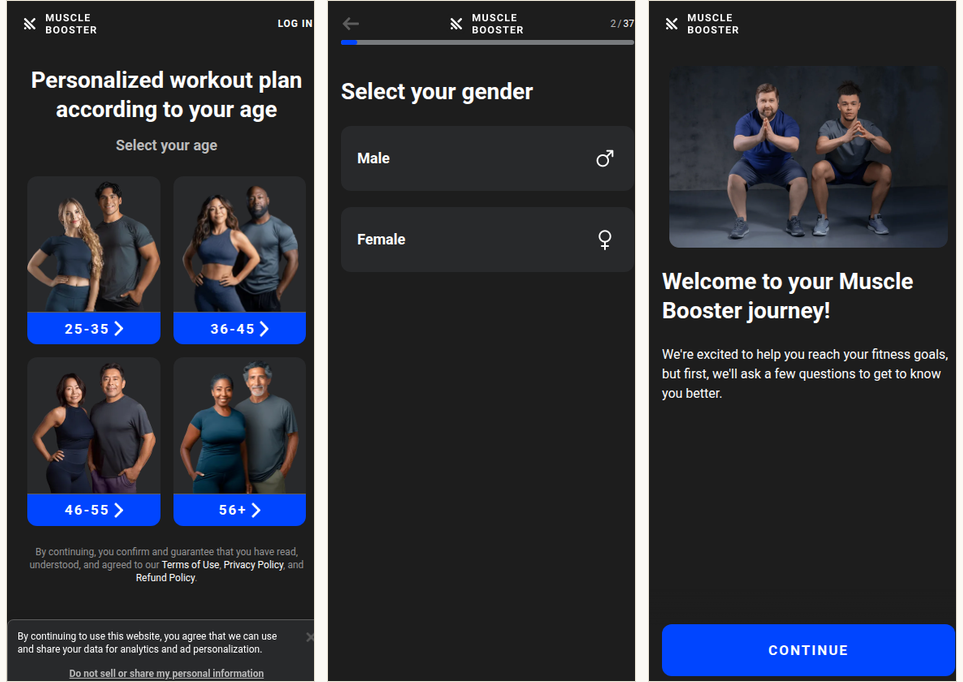
Open with the easiest tap and save hello for screen three.
An age bracket costs nothing to answer and tells the funnel which photos to show next. The welcome card lands better once the reader is already moving.
He picks the before and the after himself
Goal, body type, target body type. Three screens, eight photos, no copy beyond a label. The man taps the torso that looks like his, then the torso he wants.
Nothing here creates desire. The picture of the Bulk body was in his head before the ad ran. The funnel asks him to point at it, and from that tap on, the paywall's before-and-after is his own choice reflected back.
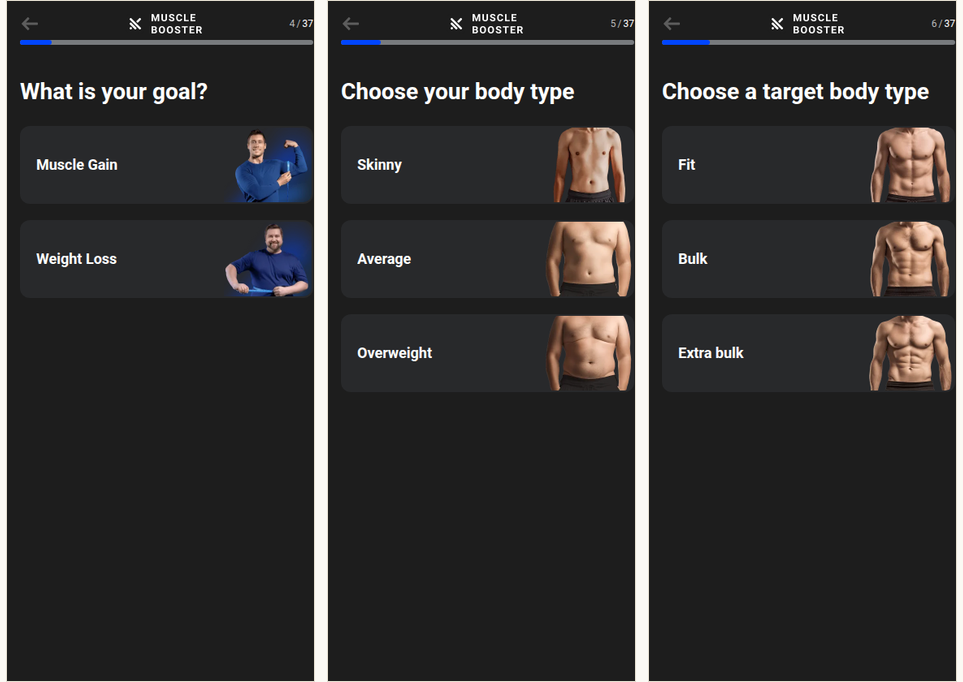
Let the user choose the after photo before you show one.
A target he picked is a promise he made. Carry it to the paywall and the before-and-after stops being your claim.
Eleven questions you can count on your fingers
Screens seven to eighteen are the assessment, and almost every question asks for something countable: push-ups, hours walked, hours slept, glasses of water. A glass is defined on screen so the count means the same thing to everyone.
Countable answers do two jobs. They make the quiz feel like a doctor's intake rather than a sales call, and they give the funnel raw material for the score it prints next. Vague questions produce vague scores.
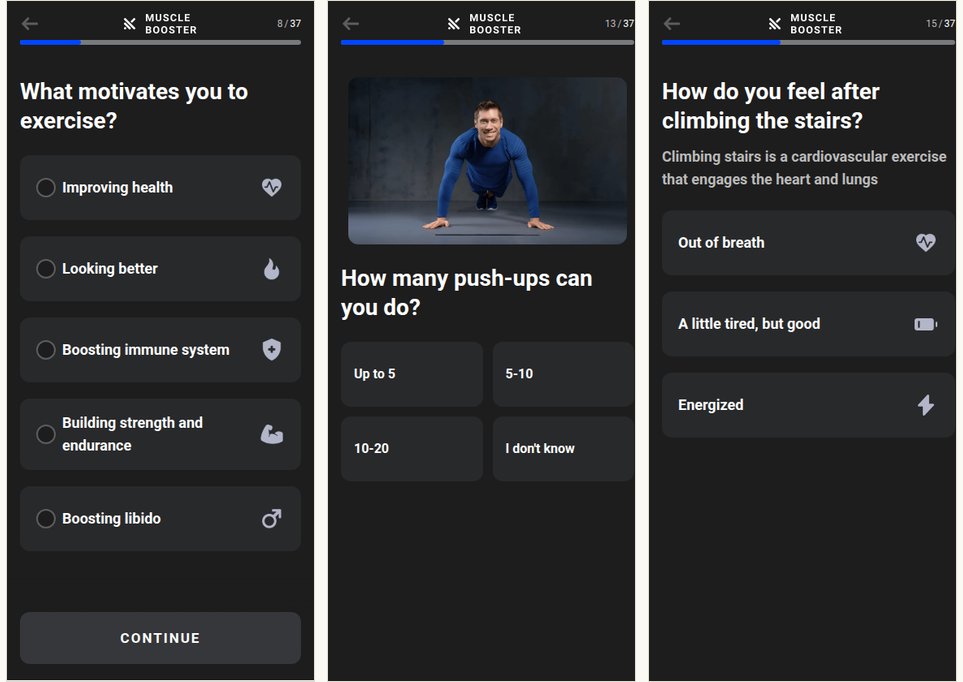
Ask for counts, not feelings.
Each count is a tap for the user and a specific for you. Specifics get believed when you hand them back on the results screen.
A score at the halfway mark, then “a few more questions”
Halfway through the quiz, before any email, Muscle Booster stops and grades you. Fitness level: intermediate. A total score, a badge that says Excellent result, three coloured bars. It reads like a report card.
The next screen is Sugarman's seed of curiosity written out in full: your plan is almost complete, we just have a few more questions. The reader has a result in hand and a better one promised. He keeps sliding.
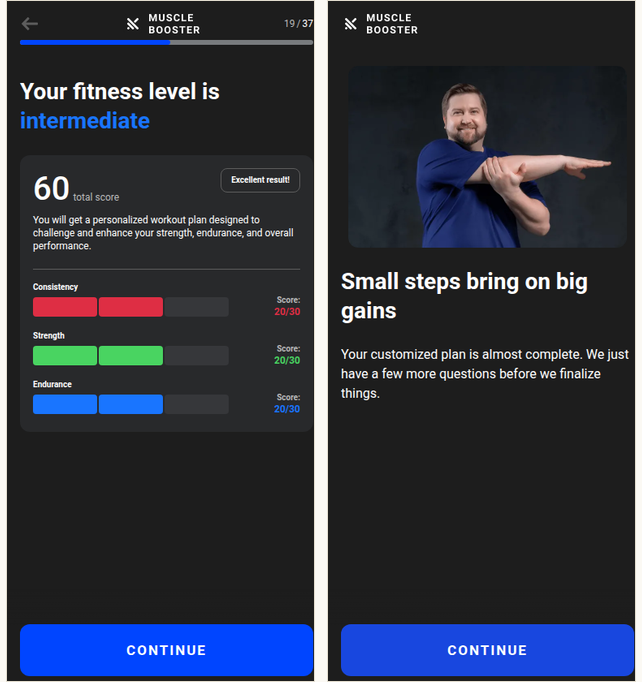
Pay out a result before the hard asks, then promise a better one.
The score makes the first half feel finished. The cliffhanger makes the second half feel short.
Four numbers typed with his own thumbs
Halbert taped a dollar bill to his letters so your hands were on the page before you decided to read. Muscle Booster's version is four input screens: height, current weight, target weight, age. Typing beats tapping. A man who has entered his target weight has already pictured the day he hits it.
Watch the tag on the screen before the inputs. Asked how often he wants to train, the funnel marks the second-lowest answer as its recommendation. It is the bar he is most likely to keep, and it teaches him that tagged options are the ones to tap.
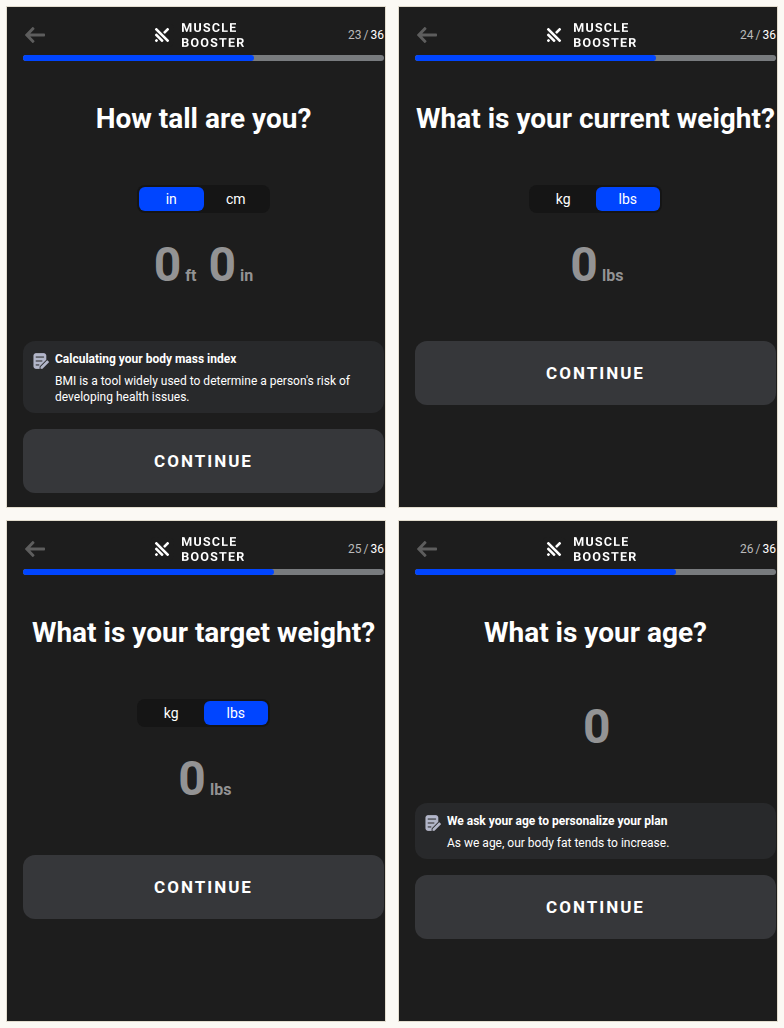
Make the user type the number the paywall will quote back.
Target weight is the one that matters. It becomes the goal on the paywall and the date on the projection, and he supplied it himself.
A chart lesson, a BMI readout, and a question about your calendar
Hopkins believed in the free sample. Muscle Booster serves two. The fitness score was the first. After the typed numbers comes the second: a marker on a BMI bar, a verdict, and a lifestyle summary beside a torso.
Between them sits a one-screen lesson on why muscle gain beats weight loss, with the funnel's own promise of a difference in days. Then a question that is really a deadline: is there a special occasion you want to gain muscle for? He names it, and the funnel has a date it did not have to invent.
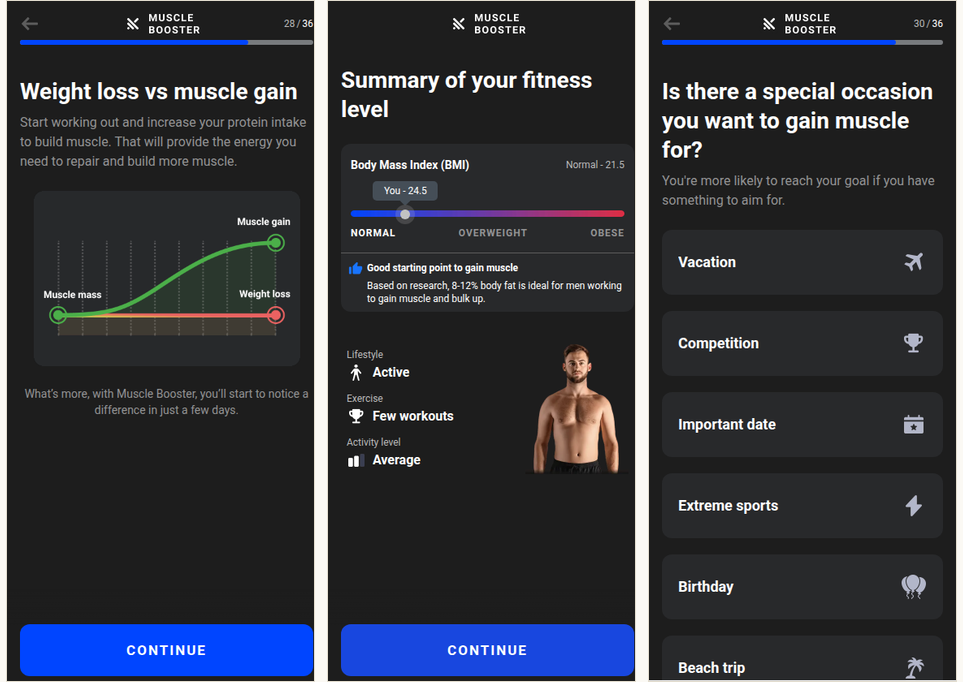
Give a second free result after the typed inputs, and let him name the deadline.
A readout built from his numbers proves the inputs were used. An occasion he picked is urgency you did not have to manufacture.
A goal weight with a date on it, then proof, then the email
Bencivenga's rule is that proof beats promise, so Muscle Booster makes the promise look like a calculation. The one and only plan you'll ever need, it says, and under that a goal weight with a day, month and year, plotted month by month.
The loader that follows is a proof wall in disguise: a world map, a user count, and rotating five-star reviews while the ring fills. Then a laurel card citing a download ranking. Only now does the email field appear, with the user count repeated as a badge beneath it.
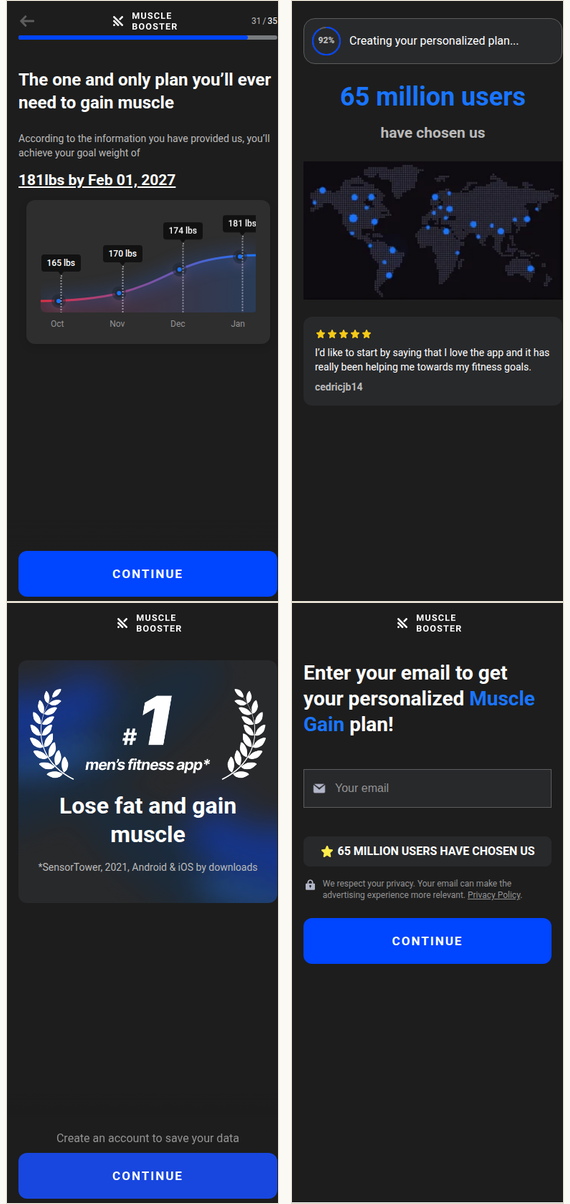
Stack the proof in the loader, where nobody can skip it.
A user count, a ranking with a source, and a review all land in the seconds the ring takes to fill. Ask for the email right after, not before.
Two clocks, one of them sitting on the plan cards
The paywall is one long page and the selling is done in the first two screens of scroll. The rest is a proof stack: an app carousel, a feature list, four reviews, a guarantee, and the plan cards repeated lower down with the clock repeated above them.
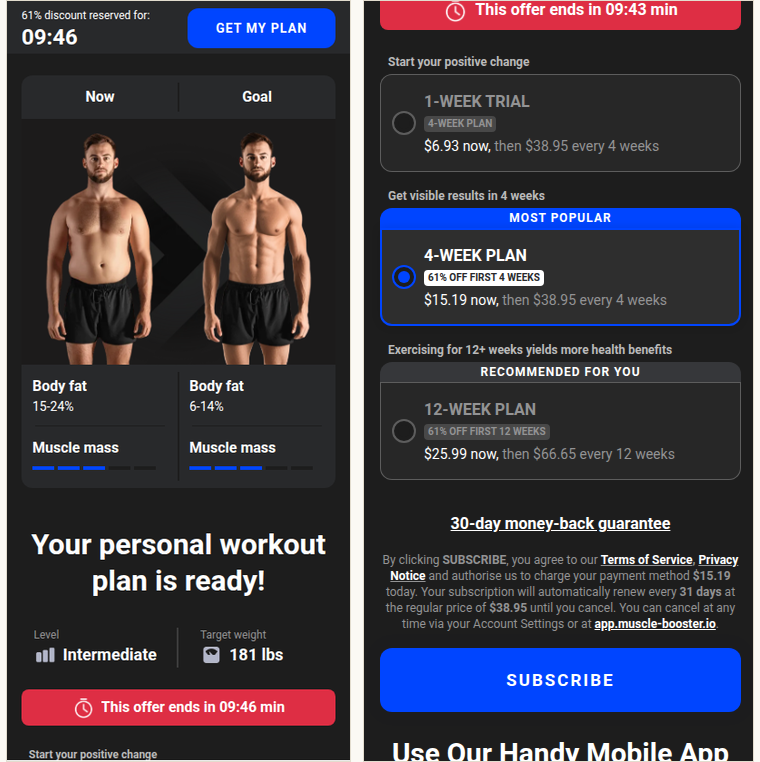
Six things in the first two screens
- A ten-minute clock in the sticky header, labelled as a reserved discount, beside the only button in view.
- Now vs Goal: the same man twice, soft belly against defined abs, with a body-fat range and muscle-mass bars under each.
- “Your personal workout plan is ready!” with the level and the target weight copied from the quiz.
- A second clock, red, directly above the plan cards, counting the same minutes.
- Three plans with a one-line reason above each, the middle one pre-ticked and tagged Most popular, the long one tagged Recommended for you.
- The renewal price inside every card (“then $38.95 every 4 weeks”) and again in the fine print, which changes with the plan you pick.
USD as captured on Oct 26. Renewal terms read from the fine print with each plan selected. The cards show no per-day price; those figures are ours.
Put the clock where the decision is, then put it there again.
One timer in the header is wallpaper. The red bar above the cards is the one he reads, and it returns above the second set of cards further down.
Close the checkout and the discount grows, with a reason attached
Tap GET MY PLAN and a checkout modal itemises the deal: full price, the discount, total today. Close it and the page changes under you. The header now reserves a bigger discount, the fine print already shows the lower charge, and the clock has started over.
A sheet slides up to explain the gift. Did you know, it asks, and quotes a training statistic with a curve. Then one sentence: we want you to become stronger, so here is a special discount. The leaver did something to earn the lower price, and the reason-why makes it read as policy rather than panic. No exit offer appeared in the September capture.
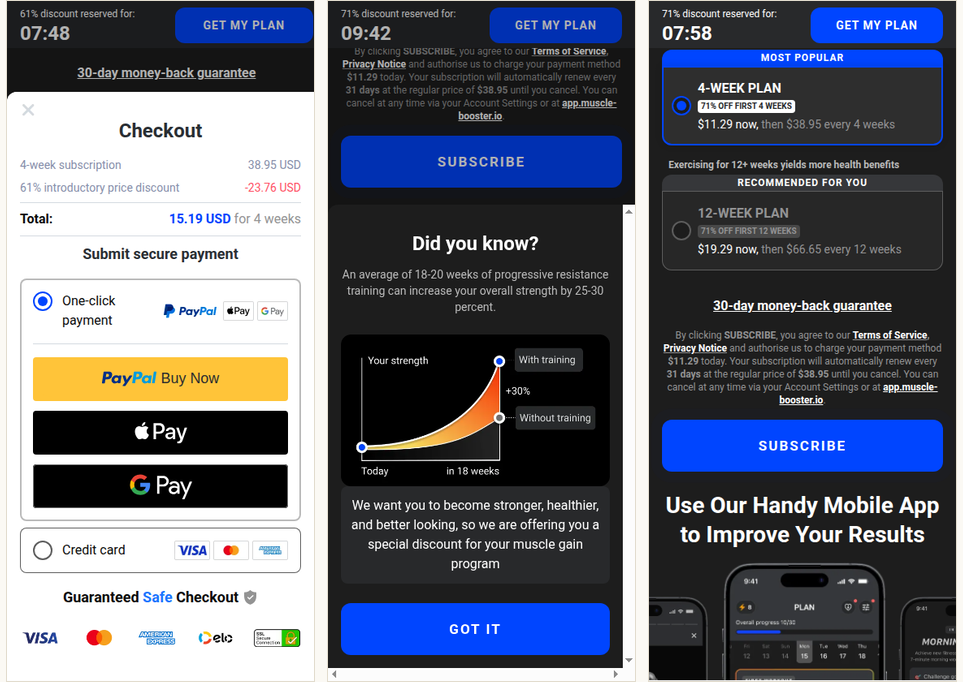
Build the second price before you need it, and give it a reason.
A deeper discount with a fact attached reads as generosity. Restarting the clock gives the second offer its own deadline instead of the dregs of the first.
The recommendation tag on the easiest honest answer. When Muscle Booster asks how often you would like to exercise, it tags “2 days per week” as OUR RECOMMENDATION. That is the lowest bar a new user will actually keep, which protects the four-week retention the plan is priced on. It also teaches the tap: by the time the paywall shows MOST POPULAR on the middle card and RECOMMENDED FOR YOU on the long one, the user has already learned that the tagged option is the right one. One label on one question, and it costs nothing to build.
Every Muscle Booster screen from both captures, every price, and the ads driving the traffic are in the Consumer App Index terminal.
250+ web2app apps tracked. New funnels captured the same week they surface, walked screen by screen so you can study the plays before your competitors do.
Get the full web2app funnel library →Already a member? Open Muscle Booster in the terminal →
Until the next walk,
— Consumer App Index
100+ captured quiz funnels, paywalls included: consumerappindex.com/terminal — already a member? That link is your fastest way back in.
